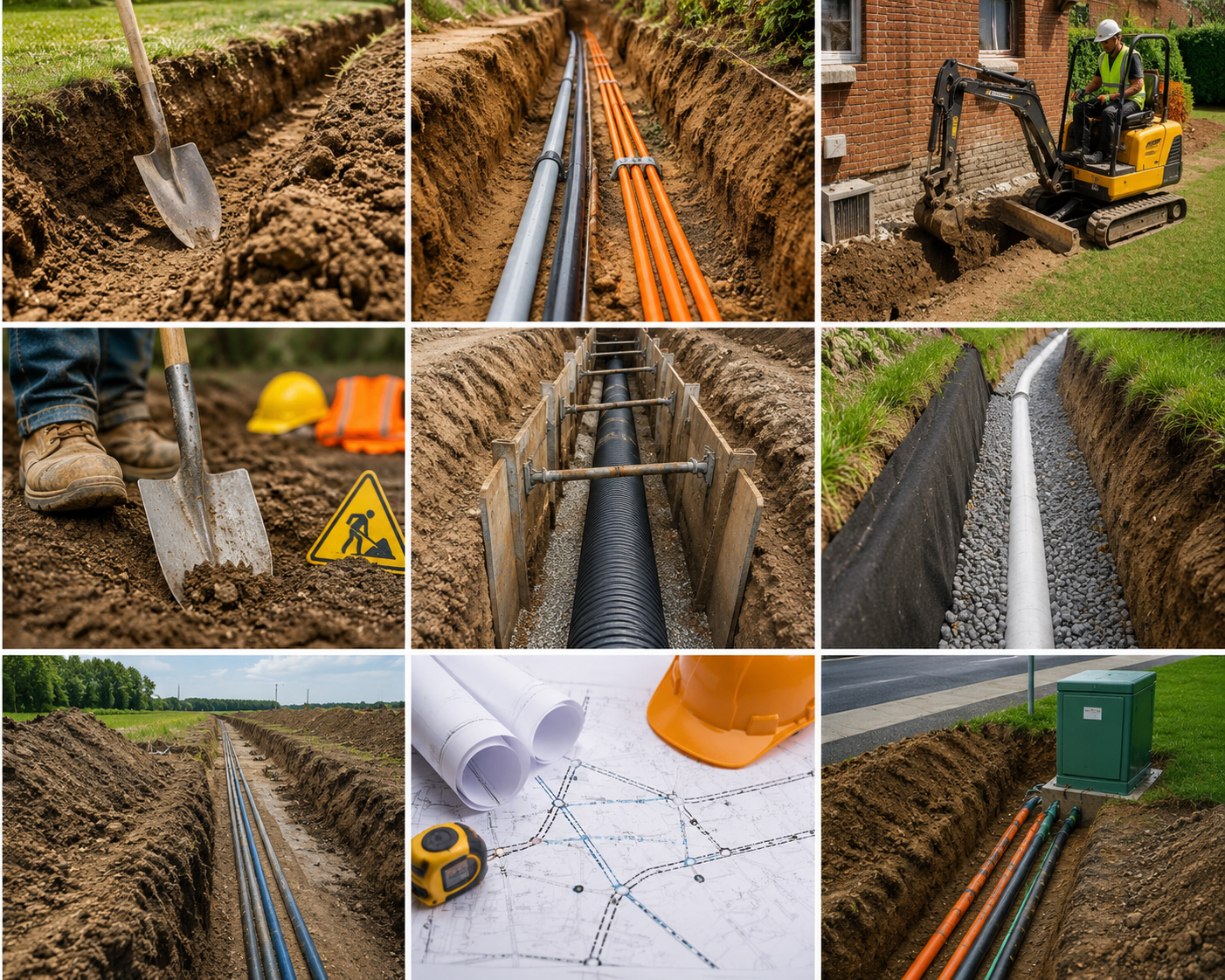
Trenching becomes more complicated when the available working area is narrow. Side yards, spaces between buildings, fenced properties, landscaped sections, and areas near existing structures can leave very little room for excavation. In these situations, careful planning matters because there may be limited space for equipment, workers, excavated soil, and installation materials.
Before you dig trench sections in a confined area, the complete work zone should be evaluated. Access, underground infrastructure, nearby structures, soil conditions, trench dimensions, and restoration requirements all influence how efficiently the project can proceed.
Why Confined-Space Trenching Requires More Planning
An open property generally provides several options for equipment movement and temporary soil storage. A narrow area offers fewer choices.
Workers may need to operate close to foundations, fences, gardens, walkways, or other permanent features. Excavated material can quickly consume available space, while limited access may restrict how the work progresses.
For these reasons, planning should extend beyond the trench itself.
Measure the Available Working Area
Start by measuring the proposed excavation area and identifying the narrowest access points.
Gates, pathways, building corners, fences, retaining walls, and landscaping may affect how the excavation area can be reached. It is better to recognize these restrictions beforehand than discover them after work begins.
The assessment should also consider where workers can move safely around the excavation.
Select the Route Strategically
In confined spaces, even a small route adjustment can make a significant difference.
The most direct path may place the excavation too close to an obstacle or leave insufficient working room. A slightly different alignment may provide better access while reducing disturbance.
Mark the proposed route clearly and examine it from beginning to end.
Consider Nearby Structures
Foundations, walls, sheds, decks, fences, and other structures deserve careful consideration when determining the excavation path.
The objective is to create the necessary underground route without disturbing more surrounding ground than required. Keeping the excavation controlled is especially important where structures limit available space.
Identify What Is Underground
Restricted surface space does not mean the underground area is uncomplicated.
Developed properties can contain water lines, electrical infrastructure, drainage components, communication lines, and other buried installations. These should be properly identified before workers dig trench sections.
Knowing what is already underground can help determine whether the proposed route is practical.
Do Not Make Assumptions Based on Property Age
Both newer and older properties can contain unexpected underground conditions.
Previous renovations, additions, landscaping changes, or repairs may have altered the soil. Excavation might encounter compacted fill, gravel, old materials, roots, or other buried obstacles.
Planning for some flexibility can make these discoveries easier to manage.
Keep Trench Dimensions Precise
Confined excavation provides little benefit from removing unnecessary soil.
An excessively wide trench reduces available working space and creates additional material that must be stored. Digging deeper than required can also add unnecessary work.
The required dimensions should therefore be established before excavation begins.
Check Measurements Frequently
Changes in ground elevation can affect trench depth even across relatively short distances.
Regular measurements help maintain consistency. A marked route can also help keep the excavation aligned when nearby structures make visual positioning difficult.
Accuracy at this stage can simplify the underground installation that follows.
Create a Soil Management Plan
Excavated material is one of the biggest logistical challenges in a restricted area.
Before workers dig trench sections, determine where the removed soil will be placed. Avoid blocking entrances, pathways, gates, or areas required for continued work.
Large soil piles should also be kept away from sensitive landscaping whenever practical.
Separate Reusable and Unsuitable Material
Excavation may produce topsoil, clay, gravel, rocks, roots, or construction debris.
Keeping suitable backfill separate from unsuitable material makes the closing stages easier. It also prevents unnecessary material from being returned to the excavation.
Good organization becomes particularly valuable when there is little room to rearrange material later.
Consider Soil and Weather Conditions
Confined sites can become difficult to manage when the ground is wet.
Rain may turn exposed soil muddy, while equipment and foot traffic can damage saturated surfaces. Water may also collect in an open excavation.
Evaluating recent weather and current ground conditions can help avoid unnecessary complications.
Watch for Changing Soil
Soil composition can vary along the route.
A trench might pass through natural soil, compacted fill, clay, gravel, or root-filled areas within a relatively short distance. Workers should adjust to actual conditions instead of expecting uniform ground throughout the excavation.
Coordinate Excavation and Installation
Limited space makes project sequencing especially important.
Leaving an excavation open longer than necessary can restrict movement through an already narrow work area. The underground installation should therefore be coordinated with excavation so each stage progresses efficiently.
Before backfilling, the completed underground work should be checked carefully.
Correcting an issue while the trench remains accessible is easier than reopening restored ground later.
Backfill Without Creating Settlement
Once installation is complete, soil should be returned with long-term stability in mind.
Loose backfill can settle after rainfall and create a depression along the former trench. Appropriate placement and compaction help reduce excessive movement.
Final grading should also match surrounding elevations.
Restore the Limited Work Area Carefully
Confined areas often sit beside buildings, walkways, fences, or gardens, making accurate restoration particularly noticeable.
The finished ground should avoid creating low spots where water can collect or raised sections that alter runoff.
Lawns, gravel, gardens, and other surfaces should be restored according to their original use. Monitoring the area after rainfall can reveal minor settlement that requires adjustment.
Conclusion
Confined property areas make trench excavation more demanding because every part of the work must fit within limited space. Access, route selection, underground infrastructure, precise dimensions, soil storage, weather, and project sequencing all require careful consideration.
When workers dig trench sections with these limitations in mind, they can keep excavation focused and reduce unnecessary disturbance. Organized material handling, careful backfilling, accurate grading, and thoughtful restoration help complete the project while preserving the surrounding property.